




































































































































































Early Signs of Prostate Cancer: Symptoms to Know
Author: RVLNSV PRASAD
Updated On: September 2026
About Us
Author Bio
Editorial Policy
Contact Us
Quick Answer
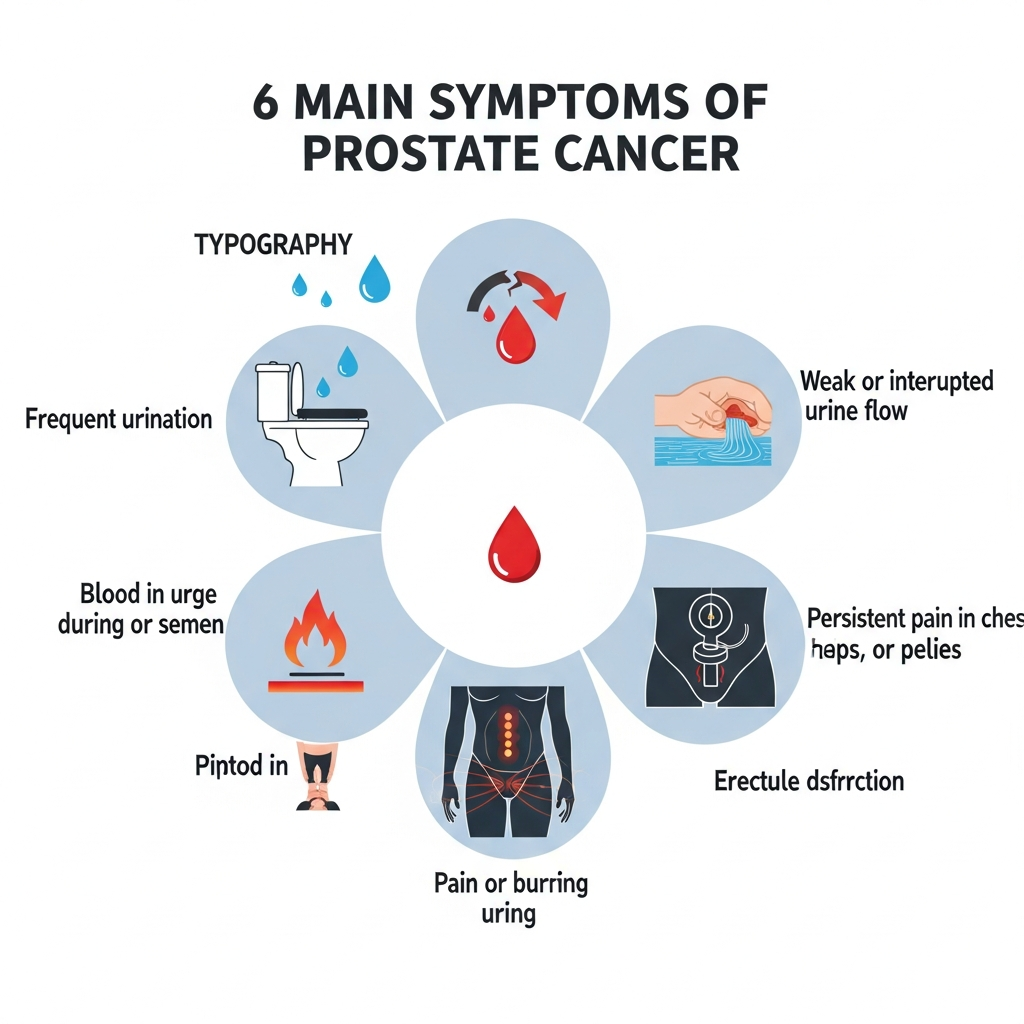
The early signs of prostate cancer can be difficult to recognize because early-stage prostate cancer often causes no noticeable symptoms. When symptoms do occur, they may include urinary changes, blood in the urine or semen, and other changes involving urination or sexual function.
National Cancer Institute: Understanding Prostate Changes
The important point is that these symptoms do not automatically mean prostate cancer. Urinary symptoms can also occur with benign prostate enlargement, prostatitis, urinary problems, and other conditions.
American Cancer Society: Signs and Symptoms of Prostate Cancer
That is why a symptom should be treated as a clue rather than a diagnosis. The purpose of recognizing prostate-related changes is not to diagnose yourself from an online article but to understand what deserves professional evaluation.
Key Takeaways
- Early prostate cancer often causes no noticeable symptoms.
- Possible symptoms can include urinary changes, blood in urine or semen, and, in advanced disease, symptoms such as back or bone pain and unexplained weight loss.
- Urinary symptoms are not specific to cancer and can have several non-cancerous causes.
- A PSA result can provide useful information, but an elevated PSA does not automatically mean prostate cancer because benign prostate conditions can also increase PSA.
- Screening and symptom evaluation are different. Screening looks for disease before symptoms appear.
- Age, family history, inherited genetic changes, and certain other factors can influence prostate cancer risk.
- Persistent or concerning changes deserve medical evaluation rather than internet-based self-diagnosis.
Introduction
A change in urination can create an uncomfortable question:
Is this simply a prostate problem, or could it be something more serious?
That uncertainty is one reason people search for the early signs of prostate cancer.
A symptom list can be useful, but a symptom list by itself can also create unnecessary fear. The same urinary change may occur because of benign prostate enlargement, inflammation, infection, bladder conditions, medication effects, or other health problems.
There is another important complication: prostate cancer may not cause noticeable symptoms during its early stages. The National Cancer Institute states that early-stage prostate cancer does not usually cause symptoms, while the NHS similarly explains that prostate cancer often has no symptoms at first.
NHS: Symptoms of Prostate Cancer
This means understanding prostate cancer requires more than memorizing a list of warning signs.
You need to understand the difference between a symptom and a diagnosis, recognize changes worth discussing with a healthcare professional, and understand why screening may be considered even when nothing feels wrong.
This guide takes that approach.
Why Early Prostate Cancer Can Be Difficult to Notice
The prostate is a small gland located below the bladder and around the upper part of the urethra, the tube that carries urine out of the body.
Mayo Clinic: Prostate Cancer — Symptoms and Causes
Where prostate cancer develops can influence whether it produces noticeable symptoms.
The NHS explains that prostate cancer often starts in the outer part of the prostate. Because that area is not immediately pressing against the urethra, symptoms may not appear until the cancer becomes larger or spreads.
This creates two important distinctions:
No symptoms does not necessarily mean no cancer.
At the same time:
Having urinary symptoms does not necessarily mean cancer.
Both statements matter.
A person who feels perfectly well may still want to discuss prostate cancer screening with a healthcare professional based on individual risk and preferences. Meanwhile, someone with difficulty urinating may have BPH or another non-cancerous condition.
That is why symptom awareness and appropriate medical evaluation belong together.
Possible Signs and Symptoms of Prostate Cancer
There is no single symptom that can identify prostate cancer.
When symptoms occur, their significance depends on the person’s medical history, the duration of the problem, other symptoms, and whether the disease is localized or has spread.
The American Cancer Society notes that early prostate cancer usually causes no symptoms, although urinary problems and blood in the urine or semen can occur in some cases.
American Cancer Society: Prostate Cancer Signs and Symptoms
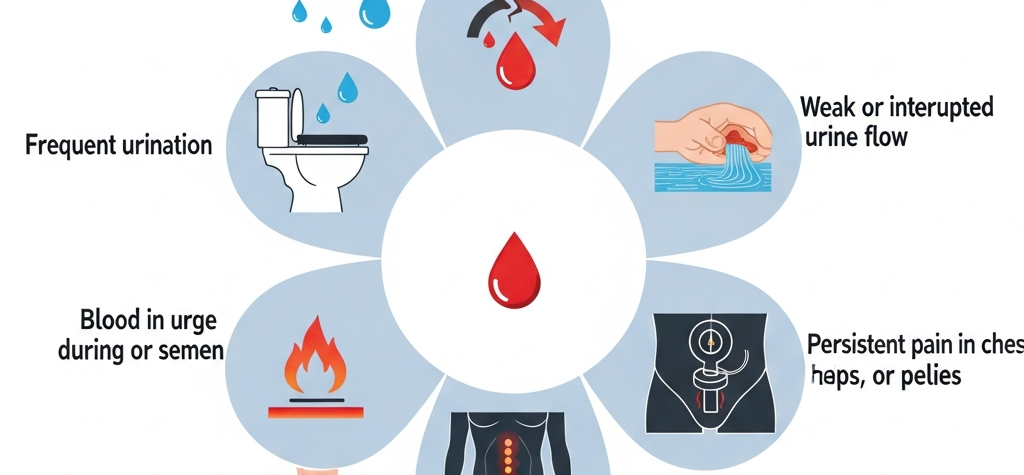
1. Changes in Urination
Urinary changes are among the symptoms people commonly associate with prostate problems.
Possible changes include:
- difficulty getting urine started
- needing to strain to urinate
- a weak or slow urine stream
- urine flow that stops and starts
- needing to urinate more frequently
- needing to urinate urgently
- feeling that the bladder has not completely emptied
- waking during the night to urinate
The NHS lists these types of urinary changes among possible symptoms of prostate cancer.
But there is an important qualification.
Urinary symptoms are not specific to prostate cancer.
Benign prostatic hyperplasia, commonly called BPH, is a non-cancerous enlargement of the prostate that can interfere with urinary flow. The American Cancer Society explains that urinary problems are more often caused by BPH than prostate cancer.
This means that a weaker urine stream should not automatically be interpreted as cancer.
The more useful question is
What is causing this change?
2. Blood in the Urine
Blood in the urine is called hematuria.
Visible blood may make urine appear:
- pink
- red
- reddish-brown
- cola-colored
Blood in the urine can occur with prostate cancer and is listed by Mayo Clinic among possible symptoms.
Mayo Clinic: Prostate Cancer Symptoms and Causes
However, blood in urine can have many other causes.
For that reason, unexplained blood should not be interpreted through an online symptom checklist.
If you notice visible blood in your urine and do not know why it is happening, medical evaluation is appropriate.
The important point is not
“Blood means cancer.”
It is:
“Unexplained blood deserves an explanation.”
3. Blood in Semen
Blood in semen can be alarming, especially when someone is already worried about prostate cancer.
It is recognized as a possible symptom of prostate cancer.
However, the presence of blood in semen does not automatically establish a cancer diagnosis.
The significance depends on the person’s age, medical history, other symptoms, persistence, and clinical findings.
Instead of immediately asking:
“Does this mean I have cancer?”
A more useful question is
“What could cause this change, and does it need to be evaluated?”
That change in thinking can reduce unnecessary fear while still encouraging appropriate medical attention.
4. Pelvic, Back, Hip, or Bone Pain
Pain requires particularly careful interpretation.
Back and bone pain can occur with prostate cancer that has spread beyond the prostate. The NHS and Mayo Clinic both identify back or bone pain as possible symptoms of advanced disease.
NHS: Symptoms of Prostate Cancer
But ordinary back pain is extremely common and has many possible causes unrelated to cancer.
A sore back after physical activity, an old musculoskeletal problem, or another common condition should not automatically be interpreted as a cancer warning.
What matters is the overall pattern.
Persistent, unexplained, worsening pain—especially when accompanied by other concerning changes—deserves medical attention.
5. Unexplained Weight Loss or Persistent Tiredness
Unintentional weight loss and significant fatigue can occur with advanced prostate cancer. Mayo Clinic includes unexplained weight loss and feeling very tired among possible symptoms when prostate cancer has spread.
These symptoms are not specific to prostate cancer.
Weight loss can have many possible causes, including other illnesses, appetite changes, digestive problems, metabolic conditions, medication effects, and other health issues.
Fatigue is even less specific.
For that reason, these symptoms should be interpreted in context rather than used as a self-screening test.
6. Sexual or Other Urinary Changes
Difficulty getting or maintaining an erection can occur with advanced prostate cancer, although erectile dysfunction has many other possible causes.
Urinary leakage can also occur with advanced prostate cancer or as a consequence of prostate cancer treatment.
These changes deserve an individualized medical assessment because sexual and urinary health can be influenced by many factors, including medications, cardiovascular health, neurological conditions, prostate disorders, and aging.
A Prostate Symptom Is a Clue, Not a Diagnosis
This is one of the most important ideas in this entire article.
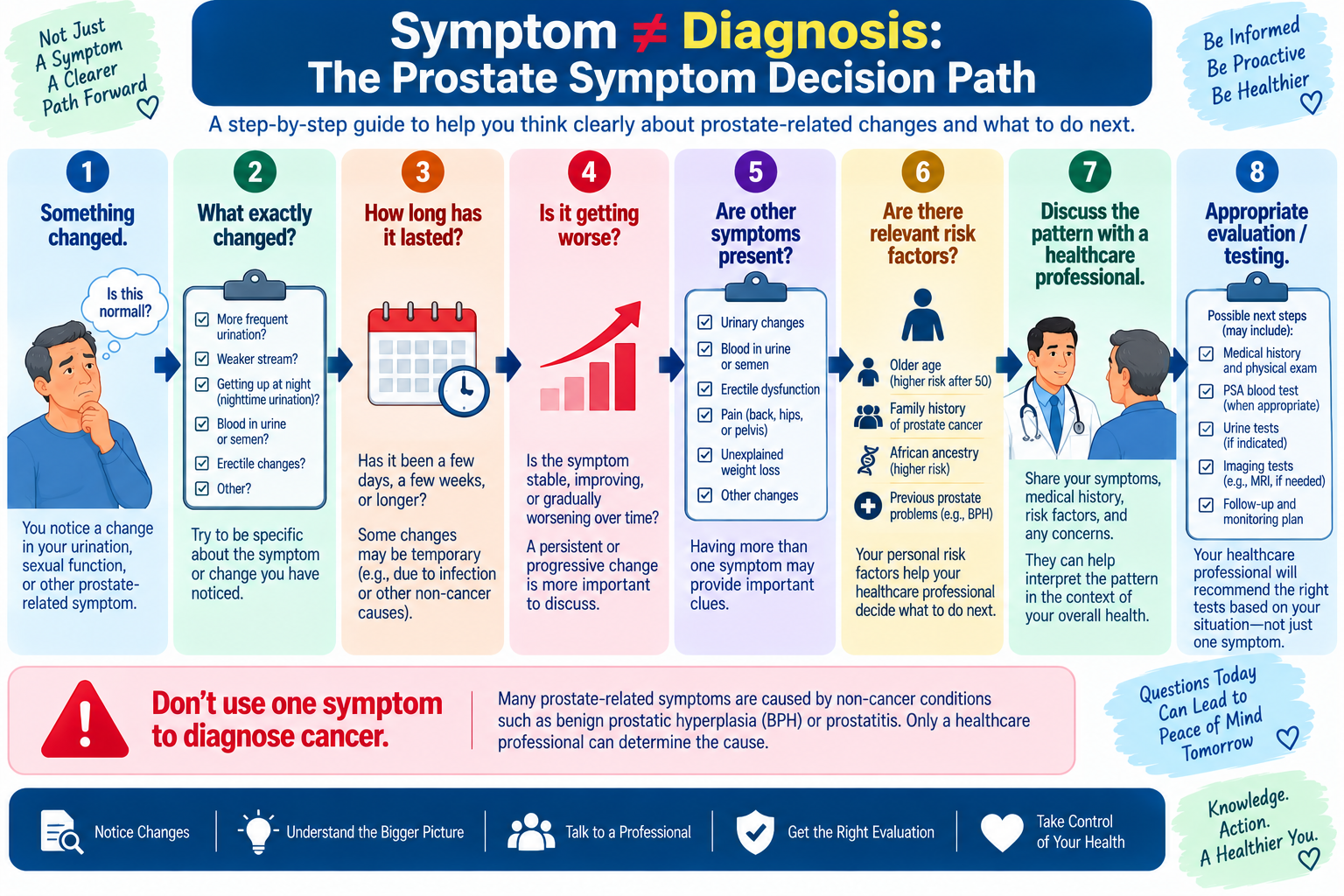
Think about the process like this:
Symptom → possible explanations → medical assessment → appropriate testing → diagnosis
Not:
Symptom → cancer
For example, consider a weak urine stream.
It can occur with BPH and other urinary or prostate conditions. A symptom alone cannot determine which condition is responsible.
The same principle applies to frequent urination.
Frequent urination can have multiple possible causes, including prostate and bladder conditions.
This is why symptom context matters.
Symptom Context Table
| What you notice | Possible explanations | What matters next |
|---|---|---|
| Weak urine stream | BPH, prostate conditions, other urinary problems | How long it has been happening and whether it is worsening |
| Frequent urination | BPH, bladder conditions, infection, other causes | Frequency, urgency, and accompanying symptoms |
| Blood in urine | Several urinary causes, including some serious conditions | Medical assessment to identify the source |
| Blood in semen | Several possible causes | Persistence, recurrence, and clinical context |
| Pelvic discomfort | Prostate, urinary, muscular, or other causes | Location, duration, and associated symptoms |
| Back or bone pain | Many common causes; advanced cancer is one possibility | Persistence, severity, and other symptoms |
| Unexplained weight loss | Many possible medical causes | Amount, duration, and accompanying symptoms |
This table is educational. It is not a diagnostic tool.
Prostate Cancer Symptoms vs. BPH Symptoms
One reason prostate symptoms can be confusing is that BPH and prostate cancer are different conditions but can produce overlapping urinary complaints.
BPH means the prostate has enlarged without being cancerous.
Because the prostate surrounds part of the urethra, enlargement can interfere with urine flow.
The American Cancer Society specifically notes that urinary difficulties are more often caused by BPH than prostate cancer.
American Cancer Society: Signs and Symptoms of Prostate Cancer
| Feature | BPH | Prostate cancer |
|---|---|---|
| Nature of condition | Non-cancerous prostate enlargement | Cancerous growth in prostate tissue |
| Urinary symptoms | Common | May occur |
| Weak urine stream | Common | Possible |
| Frequent urination | Common | Possible |
| Nighttime urination | Common | Possible |
| Early symptoms | Can produce urinary symptoms | Often no symptoms |
| Diagnosis | Requires medical assessment | Requires medical assessment and, when indicated, further testing |
The overlap is exactly why symptom interpretation alone is unreliable.
A person with urinary symptoms should not automatically assume cancer.
Likewise, someone without symptoms should not assume that cancer is impossible.
What Changes Should You Not Ignore?
Not every prostate-related symptom is an emergency.
However, certain changes should not simply be dismissed as “normal aging.”
Consider discussing persistent or concerning symptoms with a healthcare professional if you notice:
- continuing difficulty urinating
- a persistent change in urine flow
- new or worsening nighttime urination
- unexplained blood in urine
- blood in semen that persists or concerns you
- persistent pelvic discomfort
- unexplained or persistent back or bone pain
- unexplained weight loss
- significant continuing fatigue
- urinary symptoms that interfere with daily life
The NHS advises seeking medical advice when someone has difficulty urinating or other possible symptoms of prostate cancer.
NHS: When to Seek Medical Advice for Prostate Cancer Symptoms
The goal is not to assume the worst.
It is to find the cause.
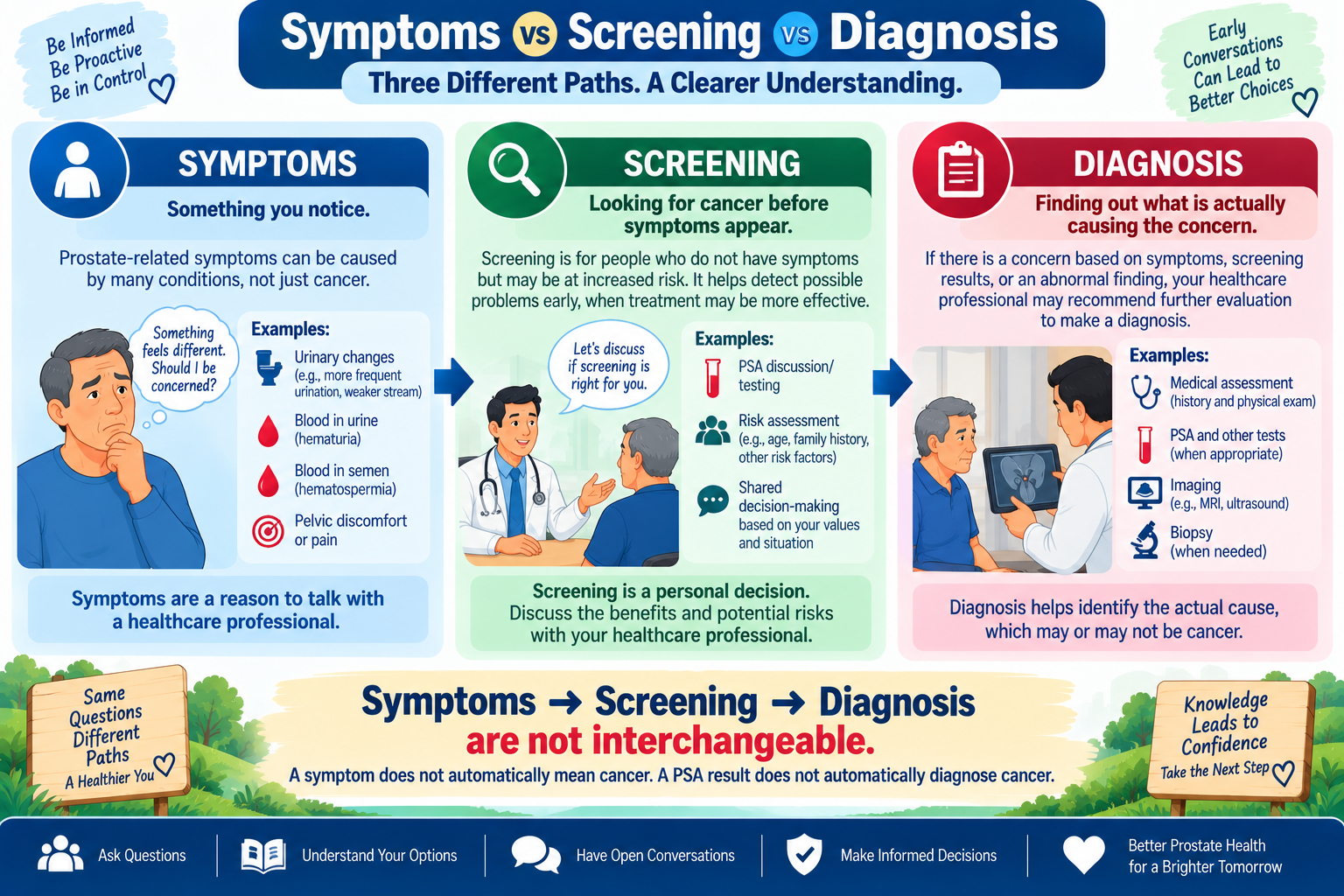
Symptoms and Screening Are Not the Same Thing
This distinction is often missing from simple articles about prostate cancer.
Symptoms
Symptoms are changes a person notices.
Examples include:
- difficulty urinating
- blood in urine
- frequent urination
- blood in semen
- pelvic discomfort
Screening
Screening means looking for cancer before symptoms develop.
The National Cancer Institute explains that screening is performed when a person does not have symptoms.
National Cancer Institute: Prostate Cancer Screening
This is why a person cannot rely entirely on symptoms to decide whether prostate cancer should be considered.
Someone may feel completely well and still discuss whether screening is appropriate based on their individual risk.
What Does a PSA Test Actually Tell You?
PSA stands for prostate-specific antigen.
It is a protein produced by normal prostate cells as well as malignant prostate cells.
A PSA test measures the amount of PSA in the blood.
National Cancer Institute: Prostate-Specific Antigen (PSA) Test
But PSA is not simple:
“cancer or no cancer”
test.
PSA can rise because of prostate cancer, but it can also rise because of benign conditions such as:
- benign prostatic hyperplasia
- prostatitis
The NCI also notes that ejaculation and vigorous exercise can temporarily affect PSA levels.
An abnormal PSA therefore does not automatically mean prostate cancer.
Depending on the circumstances, a healthcare professional may recommend repeat testing, examination, additional blood or urine tests, imaging, or biopsy.
The correct interpretation depends on the whole clinical picture.
Should Everyone Have a PSA Screening Test?
There is no simple one-size-fits-all answer.
The NCI explains that prostate cancer screening has potential benefits and harms and that there is no standard or routine screening test that applies universally.
NCI: Prostate Cancer Screening Evidence
Potential benefits of screening can include finding some cancers earlier.
Potential harms include:
- false-positive results
- anxiety
- unnecessary follow-up procedures
- overdiagnosis
- overtreatment
- treatment-related side effects
The NCI’s PSA information explains that screening decisions should involve discussion of the potential benefits and harms with a healthcare professional.
A useful conversation may include:
- age
- family history
- personal risk factors
- inherited genetic risk
- overall health
- potential benefits and harms
- personal preferences
The purpose is informed decision-making rather than automatic testing.
Who May Have a Higher Risk of Prostate Cancer?
Risk factors do not predict with certainty who will develop prostate cancer.
They change the likelihood.
The National Cancer Institute identifies older age, having a first-degree relative with prostate cancer, inherited gene changes such as BRCA1 or BRCA2 variants or Lynch syndrome, and certain racial or ethnic patterns among relevant risk factors.
National Cancer Institute: Prostate Cancer Risk Factors
The American Cancer Society also identifies age, race and ethnicity, family history, and inherited gene changes among established risk factors.
American Cancer Society: Prostate Cancer Risk Factors
Factors worth discussing with a healthcare professional include:
- increasing age
- a close relative with prostate cancer
- several relatives affected by related cancers
- known inherited cancer-related genetic changes
- other personal risk factors identified by a healthcare professional
Having a risk factor does not mean cancer is inevitable.
Likewise, not having a known risk factor does not guarantee that prostate cancer cannot occur.
How Is Prostate Cancer Diagnosed?
A symptom does not establish a diagnosis.
Evaluation begins with a healthcare professional assessing the person’s symptoms, medical history, risk factors, and examination findings.
Depending on the circumstances, evaluation may involve:
- Medical history
- Discussion of symptoms
- Physical examination
- PSA testing
- Additional blood or urine tests
- Imaging, such as MRI, when appropriate
- Prostate biopsy when needed
The NCI explains that an elevated PSA may lead to additional evaluation, which can include repeat PSA testing, a digital rectal examination, additional tests, imaging, or biopsy depending on the clinical situation.
A biopsy examines prostate tissue under a microscope and can provide the tissue evidence needed to diagnose prostate cancer.
That process is fundamentally different from searching symptoms online and deciding what disease you have.
What Happens After You Report a Prostate Symptom?
Many people delay medical care because they do not know what will happen at the appointment.
The process can be more straightforward than people expect.
Step 1: Describe exactly what changed.
Instead of saying:
“My urination is bad.”
Try to describe the actual change.
For example:
“I have been waking several times each night to urinate for the past month.”
Specific information gives the healthcare professional a clearer starting point.
Step 2: Explain when it began.
Mention whether the change appeared suddenly or gradually.
Step 3: Explain whether it is getting worse.
A stable symptom and a progressively worsening symptom provide different context.
Step 4: Mention associated symptoms.
Tell the healthcare professional about:
Step 5: Discuss medicines and supplements
Bring a list of medicines and supplements you use.
Do not stop prescribed medication on your own.
Step 6: Ask what needs to be checked
You do not need to arrive with your own diagnosis.
Your job is to explain what is happening.
The healthcare professional’s job is to determine what evaluation is appropriate.
Questions to Ask at a Medical Appointment
Taking a few questions with you can make an appointment more productive.
| Question | Why it can help |
|---|---|
| What could be causing these symptoms? | Prevents you from assuming one diagnosis |
| Could BPH or another condition explain them? | Helps you understand non-cancer causes |
| Do I need any testing? | Clarifies the next step |
| Would PSA testing be appropriate for me? | Opens a screening discussion |
| What would an abnormal PSA mean? | Prevents misunderstanding |
| Should the test be repeated? | Helps explain follow-up |
| What symptoms should make me seek care sooner? | Gives you a clear plan |
| Does my family history affect my risk? | Helps personalize risk assessment |
The “Pattern, Not Panic” Approach to Prostate Symptoms
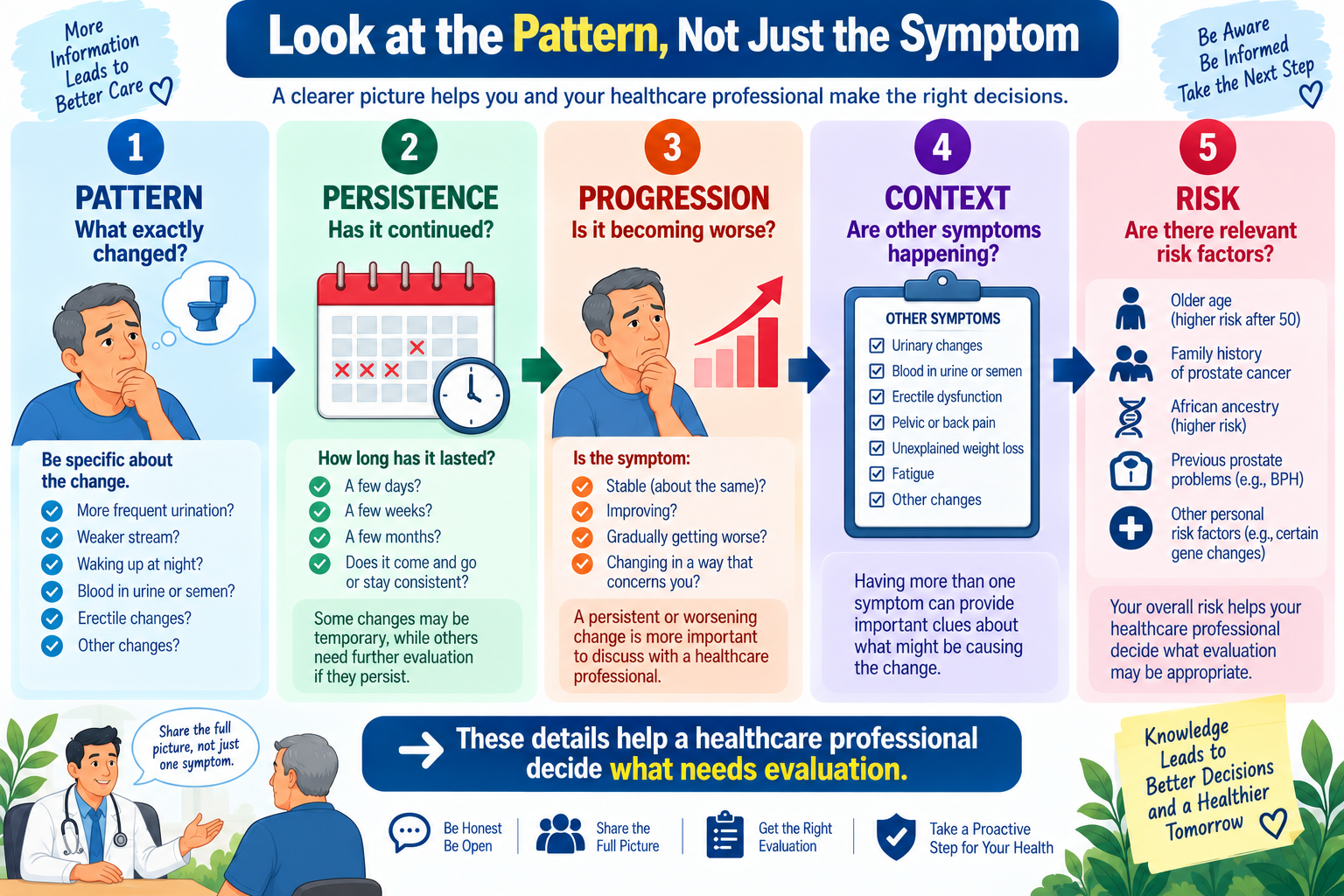
A symptom list can make people anxious because it encourages a simple yes-or-no comparison.
A better approach is to look at the pattern.
Pattern
What exactly changed?
Persistence
Has the symptom continued?
Progression
Is it becoming more frequent or severe?
Context
Are other symptoms happening at the same time?
Risk
Are there relevant family or personal risk factors?
Professional evaluation
What needs to be checked rather than guessed?
This framework is useful because symptoms rarely exist in isolation.
For example, waking once at night to urinate can have a very different context from suddenly waking several times every night while also experiencing difficulty starting urination and a progressively weaker stream.
Neither pattern allows someone to diagnose cancer.
But describing the pattern gives a healthcare professional better information to work with.
Can Lifestyle Changes Prevent or Treat Prostate Cancer?
There is no guaranteed lifestyle strategy that prevents prostate cancer.
The American Cancer Society states that there is no sure way to prevent prostate cancer.
American Cancer Society: Prostate Cancer Prevention
That does not make healthy habits irrelevant.
Regular physical activity, a balanced eating pattern, maintaining a healthy weight, avoiding tobacco, and managing overall health can support general well-being.
But healthy habits should not be presented as substitutes for appropriate medical evaluation.
They are also not replacements for evidence-based cancer treatment.
Be especially cautious with online claims about:
- supplements that supposedly “kill” prostate cancer
- special juices
- herbal cures
- high-dose vitamins
- single foods claimed to prevent cancer
- unproven detox programs
If someone has prostate cancer or is being evaluated for it, supplements should be discussed with an appropriate healthcare professional rather than used instead of evidence-based care.
My Personal Perspective
One thing I believe health information should do better is explain what a symptom does not mean.
A person searching for prostate cancer symptoms may already be worried.
If an article simply says:
“Weak urine flow can be a sign of prostate cancer.”
The reader may remember only the cancer part.
That is incomplete.
The more useful explanation is that urinary changes can occur for several reasons, including common non-cancerous prostate conditions. At the same time, persistent or unexplained changes should not simply be ignored.
That balance matters.
I also think readers deserve a clear explanation of what happens next.
A person should not have to visit several websites just to understand the difference between a symptom, a PSA test, screening, and a diagnosis.
For me, useful health writing should reduce confusion without creating false reassurance.
It should encourage appropriate medical care without turning every ordinary symptom into a frightening possibility.
That is the approach taken in this article.
The Most Important Thing to Remember
The most useful way to think about prostate cancer symptoms is not:
“Do I have one of the warning signs?”
Instead, think:
“What changed, how long has it lasted, what else is happening, and should a healthcare professional evaluate it?”
Early prostate cancer may have no obvious symptoms. When symptoms do appear, they can overlap with more common conditions such as BPH and other prostate or urinary problems.
That is why symptom awareness is valuable, but symptom-based self-diagnosis is not.
Frequently Asked Questions:
What are the early signs of prostate cancer?
The early signs of prostate cancer may include urinary changes such as difficulty starting urination, a weak urine stream, needing to urinate more often, or waking at night to urinate. Blood in urine or semen can also occur. However, early prostate cancer often causes no symptoms at all.
Mayo Clinic: Prostate Cancer Symptoms
Can prostate cancer have no symptoms?
Yes. Early-stage prostate cancer often does not cause noticeable symptoms. The NCI specifically states that early-stage prostate cancer does not usually cause symptoms.
Is frequent urination always a sign of prostate cancer?
No. Frequent urination can have many causes, including prostate and bladder conditions. Prostate cancer is only one possible explanation. Symptoms, therefore, need to be interpreted in context rather than used as a diagnosis.
Can a weak urine stream be a sign of prostate cancer?
It can occur with prostate cancer, but urinary problems are also commonly associated with BPH and other non-cancerous conditions. The American Cancer Society notes that urinary problems are more often caused by BPH than prostate cancer.
Does blood in urine mean prostate cancer?
No. Blood in urine can have many causes. Prostate cancer is one possible cause, but visible or unexplained blood should be medically evaluated rather than automatically attributed to cancer.
Can blood in semen be caused by prostate cancer?
Blood in semen can occur with prostate cancer, but it does not automatically mean cancer is present. The significance depends on the person’s circumstances and other findings. Mayo Clinic and the American Cancer Society list blood in semen among possible prostate cancer symptoms.
Is back pain an early sign of prostate cancer?
Back pain is not a specific sign of prostate cancer. Back or bone pain can occur with advanced disease that has spread, but ordinary back pain has many other possible causes.
What is the difference between BPH and prostate cancer symptoms?
BPH is a non-cancerous enlargement of the prostate and commonly produces urinary symptoms. Prostate cancer can also cause urinary changes, but early prostate cancer often produces no symptoms. Symptoms alone cannot reliably distinguish the two.
Can a PSA test diagnose prostate cancer?
No. PSA is produced by normal prostate cells and malignant cells. PSA can also rise with benign conditions such as BPH and prostatitis. An abnormal PSA may lead to additional evaluation, but it does not by itself establish a cancer diagnosis.
When should someone see a doctor about prostate symptoms?
Consider seeking medical advice for persistent difficulty urinating, unexplained blood in urine or semen, worsening urinary changes, or other symptoms that concern you. The NHS advises medical evaluation for difficulty urinating and other possible prostate cancer symptoms.
Can prostate cancer be found before symptoms appear?
Yes. Screening is designed to look for cancer before symptoms develop. However, prostate cancer screening has potential benefits and harms, so screening decisions should be discussed with a healthcare professional.
What should I do if I have one of these symptoms?
Do not assume that you have cancer, but do not ignore persistent or unexplained changes either.
Write down:
- What changed
- when it started
- whether it is getting worse
- how often it happens
- whether other symptoms are present
- which medicines and supplements you take
Then discuss the pattern with a qualified healthcare professional.
Final Thoughts
The early signs of prostate cancer are not always easy to recognize because early disease often produces no noticeable symptoms.
When symptoms do occur, urinary changes, blood in urine or semen, and certain symptoms associated with advanced disease may be among the possibilities. Yet many of these same symptoms can result from non-cancerous conditions.
That is why a symptom should be treated as information—not a diagnosis.
If something has changed, pay attention to the pattern.
Notice:
- when it started
- whether it persists
- whether it is getting worse
- whether other symptoms are present
- whether you have relevant risk factors
Then get appropriate medical advice.
A PSA test, examination, imaging, or biopsy may sometimes be part of the evaluation, but each serves a different purpose. PSA should not be interpreted as a simple cancer test because non-cancerous prostate conditions can also raise PSA.
Most importantly, do not let either fear or false reassurance make the decision for you.
Good health information should help you recognize what deserves attention, understand what remains uncertain, and know what to discuss with a healthcare professional.
Trusted Medical Sources
National Cancer Institute
NCI — Understanding Prostate Changes
Useful for prostate cancer symptoms, risk factors, and early detection.
NCI — Prostate-Specific Antigen (PSA) Test
Useful for understanding PSA, factors that can raise PSA, screening, and follow-up testing.
NCI — Prostate Cancer Screening
Useful for understanding the difference between screening and symptom evaluation.
Mayo Clinic
Mayo Clinic — Prostate Cancer: Symptoms and Causes
Useful for symptoms, advanced disease symptoms, risk factors, and general prostate cancer information.
NHS
NHS—Symptoms of Prostate Cancer
Useful for urinary symptoms, blood in urine or semen, advanced symptoms, and when to seek medical advice.
American Cancer Society
American Cancer Society — Signs and Symptoms of Prostate Cancer
Useful for distinguishing early and advanced symptoms and explaining the overlap between prostate cancer and BPH.
American Cancer Society — Prostate Cancer Risk Factors
Useful for age, family history, inherited genes, and other risk factors.
American Cancer Society — Prostate Cancer Information
Useful for prevention, treatment, and broader prostate cancer information.
About the Author
RVLNSV PRASAD is a health content writer and creator of HealthTipsToYou. His health articles are written to make evidence-based health information easier to understand and more practical for everyday readers.
Articles are researched using information from recognized medical and public health organizations.
Medical disclaimer
HealthTipsToYou provides general educational information and does not replace professional medical advice, diagnosis, or treatment. Readers with persistent, severe, unusual, or concerning symptoms should consult a qualified healthcare professional.
Related Posts
4 Holistic Approaches to Managing Chronic Pain: A Comprehensive Guide
LDL Cholesterol How to Reduce Fast: Doctor-Approved Natural Methods
10 Doctor-Recommended Natural Ways to Lower High Triglycerides
15 Ways to Improving Prostate Health Naturally: What Every Man Should Know
10 Best Natural Remedies for Erectile Dysfunction Best Proven Techniques